


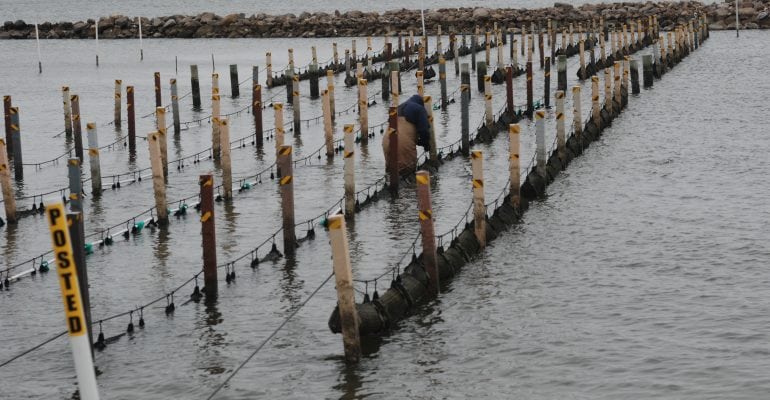
New off-bottom farming methods in Louisiana, and the Gulf region in general, are producing exceptional oysters.
“Cage” culture helps ensure improved survival, meat condition and growth over traditional on-bottom reef culture – especially when growing superior-quality oysters from Louisiana Sea Grant College Program’s bivalve breeding program. But cages won’t help if the oysters are high and dry all day long.
“Seasonal tides this time of year are lower than the rest of the year,” says John Supan, professor and director of Louisiana Sea Grant’s Oyster Research Laboratory on Grand Isle and LSU AgCenter oyster specialist. “Low tides are the best time to select sites for cage culture, to assure complete submersion year-round.”
Some farms in the Gulf region are experiencing exceptional oyster growth, reaching market-size product in six to eight months. With good site selection and farm management, two crops a year are possible because the suspended filter-feeding oysters are exposed to more water flow, hence food, than when grown on a reef. But that is all for naught if they are high and dry when growers don’t want them to be.
With some 400,000 acres of oyster leases in Louisiana, lease holders interested in alternative culture methods should begin cage culture site selection during extreme low tide. “Not all oyster leases are eligible for the additional permitting cage culture requires,” says Supan. “Site selection is your first decision to make and the most important. Site selection also dictates what gear to use and how to use it.”
Oyster lease holders or persons with permission to use leases or private water bottoms can contact Supan via email ([email protected]) or by telephone (985-264-3239) for more information and assistance in site, gear and farm management options, as well as permit application assistance.
Since its establishment in 1968, Louisiana Sea Grant has worked to promote stewardship of the state’s coastal resources through a combination of research, education and outreach programs critical to the cultural, economic and environmental health of Louisiana’s coastal zone. Louisiana Sea Grant, based at Louisiana State University, is part of the National Sea Grant Program, a network of 33 programs in each of the U.S. coastal and Great Lakes states and Puerto Rico/U.S. Virgin Islands.
###