

The Direct Enhancement of Snapper Conservation and the Economy through Novel Devices Act of 2020 (DESCEND Act of 2020) was signed into law on January 13, 2021. The new Act will require commercial, for-hire, and private recreational vessels to have a venting tool or descending device rigged and ready to use when fishing for reef fish species in Gulf of Mexico Federal waters. The requirements of the DESCEND Act of 2020 will go into effect on January 13, 2022.
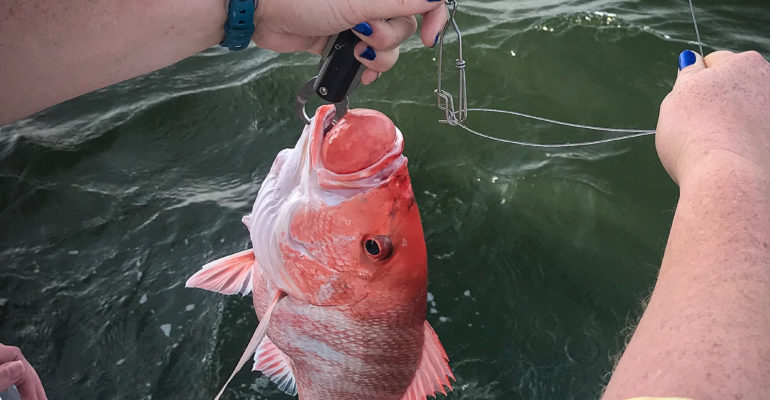
The DESCEND Act of 2020 was passed in an effort to reduce mortality caused by barotrauma on reef species, like red snapper. Barotrauma is an increase in internal gas pressure caused by the sudden changes in pressure that fish undergo when being reeled up from depths generally greater than 90 feet, though it can occur in shallower waters of 33 feet or more. Fish experiencing barotrauma have difficulty quickly swimming back to catch depth, often floating on the surface where they are vulnerable to attack by dolphins, sharks, and birds. Signs of barotrauma in a fish include a distended abdomen, bulging eyes, an everted stomach, and bubbling under the scales.
Descending devices are a weighted hook, lip clamp, or box that will hold a fish as it is lowered to a sufficient depth to allow for recovery from barotrauma. A venting tool is a sharpened, hollow instrument that can penetrate a fish’s abdomen to release excess gas acquired as it was brought to the surface.
NOAA Fisheries is currently seeking comments on a proposed rule to clarify descending device and venting tool definitions for the DESCEND Act. The public comment period is open through December 9, 2021. To view the proposed rule changes and submit public comment please visit https://www.fisheries.noaa.gov/bulletin/request-comments-proposed-rule-clarify-descending-device-and-venting-tool-definitions.
For more information on barotrauma, the different types of devices, and how to use them visit the LDWF Spotlight on Barotrauma at https://www.wlf.louisiana.gov/page/barotrauma.
The Louisiana Department of Wildlife and Fisheries is charged with managing and protecting Louisiana’s abundant natural resources. Help us protect your hunting and fishing heritage while preserving habitat, wildlife, and aquatic resources by purchasing your license at www.wlf.la.gov. To receive email or text alerts signup here.